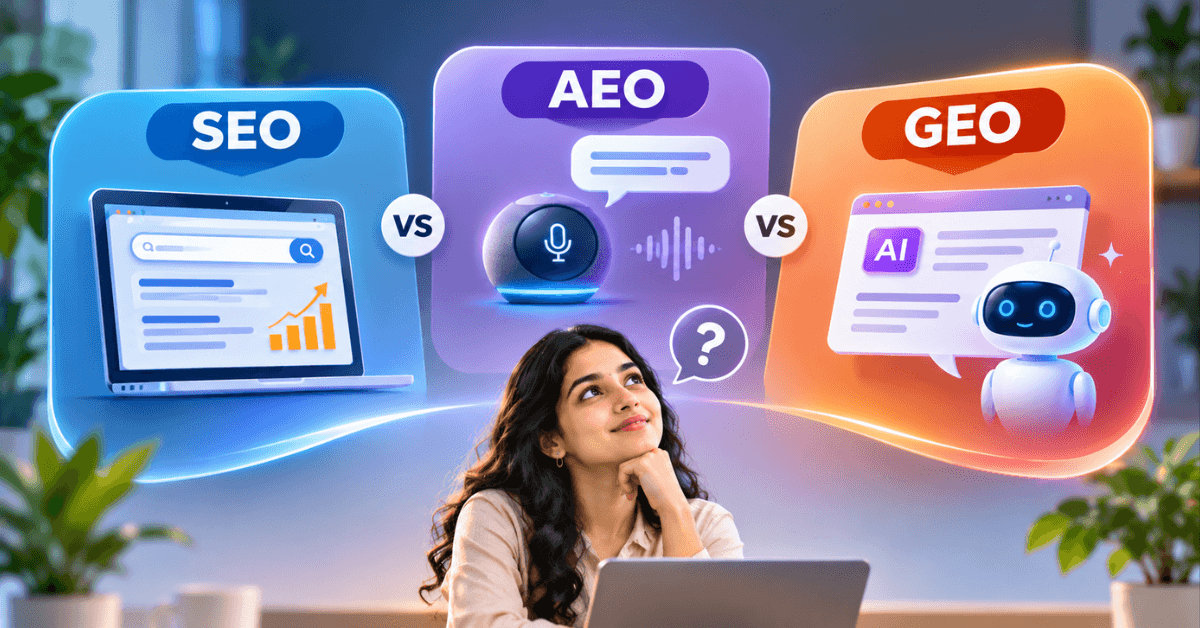

For more than two decades, search marketing in India followed a predictable playbook: conduct keyword research, build backlinks, tweak meta tags, and compete for the top three blue links on Google. But search behaviour is experiencing its most radical shift since the advent of mobile browsing. With the rollout of Google AI Overviews, Perplexity AI, ChatGPT Search, and Microsoft Copilot, millions of users are getting direct, synthesized answers without clicking through multiple websites.
This paradigm shift has introduced a critical discipline: Generative Engine Optimisation (GEO). If your brand relies exclusively on traditional organic search to capture enquiries, consultation calls, or e-commerce orders, resting on conventional SEO tactics alone leaves you vulnerable to zero-click searches. Indian businesses that adapt early to generative discovery will capture mindshare, while those clinging strictly to outdated ranking metrics risk becoming invisible.
What Is Generative Engine Optimisation (GEO)?
Generative Engine Optimisation (GEO) is the practice of structuring, refining, and distributing digital content so that Large Language Models (LLMs) and AI-driven search engines select, synthesize, and cite your brand as a trusted source in their generated answers.
While traditional SEO focuses on convincing an algorithm to place your URL on page one of Search Engine Result Pages (SERPs), GEO focuses on convincing generative models that your data, quotes, statistics, and perspectives are authoritative enough to be incorporated directly into conversational answers.
| Comparison Factor | Traditional Search Engine Optimisation (SEO) | Generative Engine Optimisation (GEO) |
|---|---|---|
| Primary Goal | Rank specific URLs in the top 10 organic search listings. | Earn citations, brand mentions, and synthesized references in AI responses. |
| Discovery Mechanism | Search crawlers indexing web pages based on links and keywords. | RAG (Retrieval-Augmented Generation) scanning authoritative knowledge bases. |
| Content Structure | Keyword-dense articles with standard heading hierarchies. | Direct answers, structured data, extractable quotes, and statistical proof points. |
| Primary Metric | Organic impressions, clicks, click-through rate (CTR), keyword positions. | Brand share of voice in LLM responses, citation frequency, referral authority. |
| Conversion Focus | Website visits leading to on-page lead capture forms. | Zero-click brand recommendation, high-intent referral traffic from citations. |
Why Indian Businesses Must Prioritize GEO Right Now
India’s digital ecosystem presents unique commercial dynamics that make GEO an immediate operational priority rather than a speculative experiment:
- Explosive Growth of Conversational Queries: Indian consumers increasingly query search engines using natural speech patterns, regional context, and long-tail multi-layered questions rather than robotic keywords. Generative engines excel at answering these nuanced queries.
- Combating the Zero-Click Reality: When a user searches for vendor comparisons, business setup steps, or product recommendations, AI summaries answer them immediately above the fold. Being cited inside that AI Overview is the primary way to retain organic visibility.
- High-Trust Decision Making: Indian B2B buyers, clinic patients, and higher education aspirants conduct extensive diligence. When an AI search engine names your company as an industry standard, it acts as an immediate third-party endorsement.
- First-Mover Advantage in Local Sectors: While competitors continue publishing generic keyword-stuffed articles, companies that structure their sites for LLM comprehension can capture early topical authority across Indian industrial, commercial, and tech niches.
Core Principles: How Generative Engines Select Sources
Generative models like Google Gemini and OpenAI search don't just count incoming links; they evaluate information density and factual reliability using Retrieval-Augmented Generation (RAG). To win citations, your content must satisfy four primary criteria:
1. High Information Density & Direct Answers
AI models favor concise, unambiguous statements over generic introductory filler. State definitions, processes, pricing benchmarks, and frameworks upfront within the first two sentences of each section.
2. Proprietary Data & Original Research
LLMs are trained on existing web corpora. If your article merely repeats what fifty other blogs say, an AI engine has no incentive to cite your specific domain. However, publishing original survey data, case study metrics, or industry price trends forces AI engines to credit your domain as the primary source.
3. Schema Markup & Machine-Readable Architecture
Clean technical foundations allow AI scrapers to ingest your entity relationships instantly. Implementing structured Schema.org markup (such as Organization, Article, FAQPage, Service, and Product schema) removes ambiguity about what your business offers. If you want to refine this technical layer, reviewing our practical guides on domain authority factors and technical crawling helps lay the groundwork.
4. Cross-Platform Brand Footprint (Digital PR)
Generative engines cross-reference multiple trusted platforms to confirm a business's credibility. Mentions across industry directories, trade publications, and professional networks like LinkedIn validate your topical expertise. Learn more about establishing this baseline in our guide to building a strong digital presence.
Actionable GEO Blueprint for Indian Enterprises
Implementing Generative Engine Optimisation does not require discarding your established SEO foundation; it requires upgrading how your content is formatted, validated, and distributed.
| Strategic Pillar | Implementation Action | Expected AI Discovery Outcome |
|---|---|---|
| Factual Formatting | Add bullet points, comparison tables, and TL;DR summaries at the start of topics. | Provides easy parsing targets for AI summarization algorithms. |
| Authoritative Quotes | Include verified quotes from named internal founders, engineers, or strategists. | Supplies LLMs with human expertise signals and attributable perspectives. |
| Topical Entity Clusters | Interlink foundational service pages, deep-dive blogs, and case studies systematically. | Establishes deep semantic relevance across a specialized commercial subject. |
| Data Grounding | Publish specific numbers, timeframes, conversion rates, and localized pricing tiers. | Increases factual retrieval likelihood during RAG operations. |
- Re-engineer Content with the Q&A Method: Audit your primary service landing pages. Convert ambiguous headings into explicit customer questions, followed immediately by direct, factual answers before elaborating.
- Publish Concrete Industry Case Studies: Highlight real operational figures. Document client outcomes, project timelines, and tangible results in your portfolio or case studies to generate unique entity associations.
- Optimize Local & Corporate Entities: Maintain consistent NAP (Name, Address, Phone) data, verified business listings, and authoritative profiles. For organizations serving regional markets, our focused local SEO services help bridge local pack performance with modern search discovery.
- Track AI Referral Traffic Accurately: Ensure your analytics setup correctly tags referrals originating from domains like
chatgpt.com,perplexity.ai, orandroid-app://com.google.android.googlequicksearchbox. Our team can help you build custom dashboards through dedicated web analytics tracking and reporting.
Will GEO Replace Traditional SEO?
GEO will not replace SEO; it is the natural evolution of search marketing. Traditional web crawlers and indexers still form the underlying data layer that generative engines rely upon to discover new information. A site plagued by crawl errors, redirect loops, poor technical architecture, or slow response times will remain invisible to both traditional search engines and AI models.
The most effective strategy is a hybrid organic growth model: maintain rock-solid technical hygiene, earn quality backlinks, and optimize your content structure so both traditional indexing spiders and conversational AI agents cite you as the category leader.
Upskill Your Team on AI-Driven Search
Navigating the shift toward generative search requires updated competencies across content writing, engineering, and digital marketing teams. If your marketing staff wants hands-on exposure to leveraging generative tools, explore our specialized AI & automation training or enroll in our complete digital marketing course.
Frequently Asked Questions
What is the main difference between SEO and GEO?
Traditional SEO focuses on positioning web links at the top of conventional search result pages to win clicks. GEO focuses on structuring content so generative AI systems (like ChatGPT, Perplexity, and Google AI Overviews) extract and cite your brand directly within conversational answers.
How can small businesses in India optimize for AI search?
Small businesses should focus on high information density, direct answers to customer questions, maintaining clear schema markup, claiming verified directory profiles, and publishing original case studies or regional data that AI models cannot find elsewhere.
Do backlinks still matter for Generative Engine Optimisation?
Yes. LLMs and RAG-based search engines prioritize citations from domains that possess high third-party trust and real-world authority. Backlinks from reputable industry sites continue to act as foundational trust signals that validate a source's accuracy.
How do I measure whether my website is appearing in AI search engines?
Monitor referral traffic in Google Analytics 4 from generative search domains (such as ChatGPT, Perplexity, and Copilot), track branded search lift, and periodically test key commercial prompts across AI search engines to measure your brand’s citation frequency against competitors.