Launching a website without a deliberate page architecture is like opening a commercial retail store without signs, aisles, or a checkout counter. Many small business owners make the mistake of condensing everything into a single, generic homepage, or creating thin placeholder pages that fail to answer essential customer questions. When prospective clients cannot find pricing clarity, service specifics, credentials, or immediate ways to get in touch, they leave within seconds.
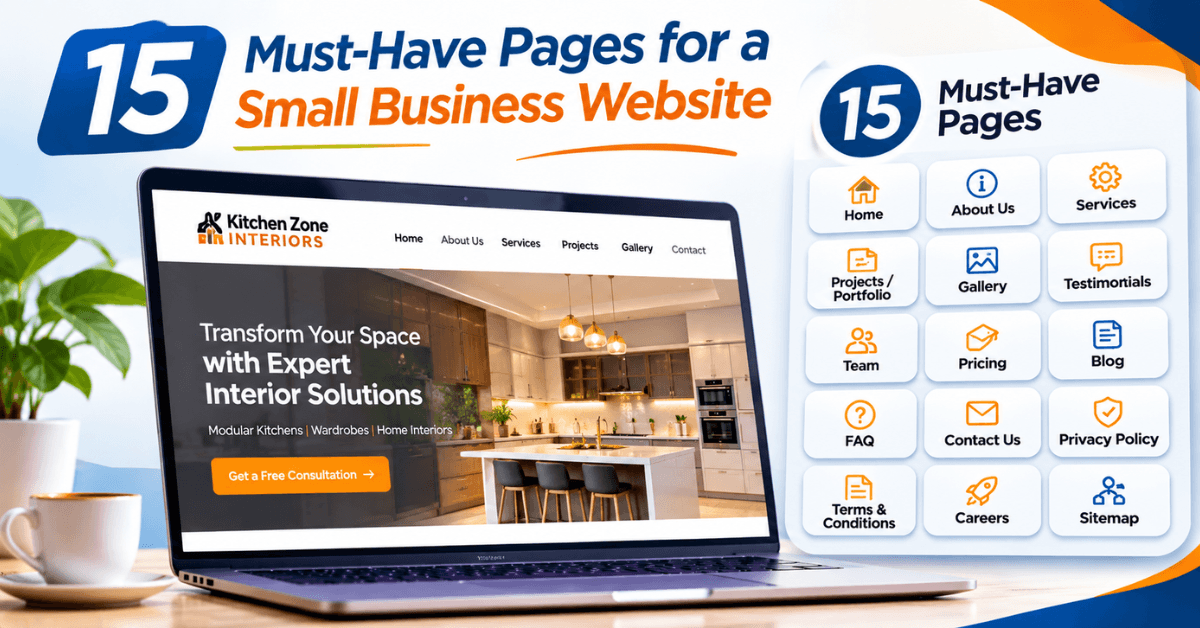
Every page on your website must serve a distinct purpose within the customer acquisition journey: building topical authority for search engines, establishing operational credibility, answering common objections, or converting traffic into paying clients. If you are building a custom site from scratch or restructuring an existing property, here are the 15 non-negotiable pages every small business website requires to drive sustainable growth.
The Small Business Website Architecture Matrix
A balanced website integrates core conversion assets, trust builders, and organic acquisition hubs:
| Page Category | Primary Commercial Objective | Essential Conversion Elements |
|---|---|---|
| Core Commercial Pages | Introduce value proposition, capture inbound leads, and facilitate direct contact. | Clear headline, benefit points, direct action buttons, frictionless enquiry forms. |
| Trust & Authority Pages | Overcome buyer hesitation, prove technical competence, and display compliance. | Client logos, real case studies, founder background, accreditations, reviews. |
| Organic Growth & Content Hubs | Capture high-intent search queries and demonstrate subject-matter expertise. | Topic-focused guides, structured tables, internal service links, downloadable resources. |
| Legal & Operational Pages | Ensure regulatory compliance and protect the business against liability. | Cookie disclosures, refund terms, privacy commitments, data processing rules. |
Core Commercial & Acquisition Pages
1. High-Impact Homepage
Your homepage is your digital storefront. Rather than trying to tell your entire company history, its primary job is orientation: explaining what your business does, who you serve, why you are different, and what action visitors should take next. Keep hero sections focused with one primary value proposition and a direct call-to-action (CTA).
2. Dedicated Individual Service Pages
Never lump all your offerings onto a single, cluttered "Services" page. Search engines rank individual URLs for specific search queries, not broad summaries. If you offer search optimization, digital advertising, and web engineering, each capability needs its own dedicated landing page. Check how we separate our SEO services and digital marketing capabilities into distinct, high-intent service hubs.
3. Contact Us Page
Friction on the contact page kills conversions. Provide multiple communication channels to match customer preferences: an embedded enquiry form, a direct telephone number, an official corporate email, and an instant messaging touchpoint. Ensure your physical address is clearly stated alongside an embedded Google Map, especially if you rely on local SEO services to drive local walk-ins and phone calls.
4. Transparent Pricing & Packages Page
Hiding pricing behind mandatory discovery calls often drives qualified prospects to competitors who offer upfront estimates. Even if your business provides tailored quotes, a dedicated pricing page outlining baseline retainers, project minimums, tier deliverables, and scope inclusions establishes immediate transparency and qualifies leads before they enter your pipeline.
5. Strategic Landing Pages for Paid Campaigns
Sending paid Google Ads or Meta traffic to your general homepage wastes ad spend. High-converting campaigns require stripped-back, dedicated landing pages that match the exact promise of the advertisement, feature zero navigational distractions, and drive toward a single goal. To understand attribution on these pages, explore our practical guide on the programmatic advertising ecosystem.
Trust & Authority Pages
6. About Us / Founder Story
People buy from people, not faceless corporations. An effective about page goes beyond corporate boilerplate; it highlights the founder’s background, executive leadership, technical qualifications, team values, and why the company exists. If you want to see how this builds personal authority, check out our own about profile.
7. Case Studies & Portfolio Showcase
Prospects need proof that you can deliver tangible results. A dedicated portfolio page detailing client baseline metrics, challenges faced, solutions deployed, and quantifiable return on investment provides definitive evidence. Browse our live SEO portfolio and case studies to see how structural data proof points build authority.
8. Reviews, Testimonials & Client Endorsements
While customer testimonials can be scattered across service pages, a centralized page housing video reviews, verified Google Business Profile ratings, and client quotes acts as an undisputed social proof hub. Learn how public recommendations impact prospective buyers in our breakdown on the power of recommendations.
9. Frequently Asked Questions (FAQ) Hub
An exhaustive FAQ page addresses standard buyer objections, payment structures, project timelines, and operational onboarding procedures. Structuring this content with clean semantic markup also helps your business capture direct search answers, reinforcing your visibility across voice search and generative engines.
Organic Growth & Community Pages
10. Educational Blog & Insights Hub
A well-maintained insights blog is the foundation of your inbound marketing. Informational articles answer prospective customer questions, establish topical authority, and funnel organic traffic toward relevant commercial pages. Review our guide on the role of content marketing in SEO to understand how editorial assets support commercial rankings.
11. Free Tools, Checklists & Lead Magnets
Offering actionable utility assets—such as downloadable checklists, templates, audit spreadsheets, or calculators—converts passive readers into engaged email subscribers. Explore our repository of free business checklists to see how utility pages capture top-of-funnel prospects.
12. Live Workshops & Training Programs
If your organization offers corporate coaching, institutional bootcamps, or upskilling, host a centralized workshops page. Providing individual downloadable syllabi and registration details allows enterprise teams and academic heads to evaluate your curriculum quickly.
13. Careers, Internships & Hiring Page
As your small business expands, a dedicated current openings or internship portal attracts top-tier talent without depending solely on expensive recruitment platforms. Outline company perks, role expectations, and the application process clearly.
Legal & Operational Compliance Pages
14. Privacy Policy Page
A transparent privacy policy is legally mandatory across most jurisdictions and required by advertising networks like Google Ads and Meta. It explains what user data you collect (via cookies, analytics trackers, or enquiry forms), how that data is stored, and whether it is shared with third parties.
15. Terms of Service & Refund Policy
Your terms and conditions protect your business by establishing payment deadlines, service boundaries, intellectual property ownership, dispute mechanisms, and cancellation guidelines. Clear legal parameters protect your operating margins and prevent client disputes.
Page Prioritization Checklist for New Small Businesses
If you have limited time or budget, launch your website systematically using a phased rollout:
| Rollout Phase | Pages to Build & Publish | Primary Milestone |
|---|---|---|
| Phase 1: Foundation (Day 1–7) | Homepage, Top 3 Service Pages, Contact Us, Privacy Policy. | Establish a functioning baseline capable of collecting verified customer leads. |
| Phase 2: Authority (Day 8–20) | About Us, Case Studies / Portfolio, Testimonials, Terms of Service. | De-risk buying decisions and prove operational competence to prospective clients. |
| Phase 3: Scale (Day 21–45) | Pricing Packages, Blog Hub, Free Checklists/Tools, Workshops, Careers. | Drive scalable inbound organic search traffic and build a compounding lead engine. |
Measurement & Ongoing Page Optimization
Publishing these 15 pages is only the beginning. Once live, every URL must be instrumented with robust event tracking via Google Tag Manager and GA4 to measure button clicks, form submissions, and user drop-off points. To establish complete visibility over your digital infrastructure, explore our professional analytics configuration services and ongoing SEO consulting.
Frequently Asked Questions
Can a small business start with a single-page website?
While a single-page website is quick to launch, it severely limits your growth. Search engines cannot rank a single URL for dozens of distinct commercial keywords, and tracking distinct conversion funnels becomes difficult. Multi-page architectures consistently outperform one-page sites in organic reach and lead volume.
Why is a separate pricing page recommended if services are customized?
Even if exact project pricing varies, prospective clients search for pricing information to determine if your service fits their budget. A pricing page outlining minimum engagement sizes, typical tiers, or scope factors builds trust and prevents time wasted on unqualified calls.
How many service pages should a small business create initially?
Start with 3 to 5 core service pages representing your most profitable and in-demand offerings. Each page should target specific customer pain points and keywords rather than grouping multiple capabilities together.
What legal pages are mandatory for a small business website?
At a minimum, every commercial website collecting user data, tracking visitors with cookies, or running digital ads must display an accessible Privacy Policy. A Terms of Service and Refund Policy page is also strongly recommended to define commercial terms and protect against liability.