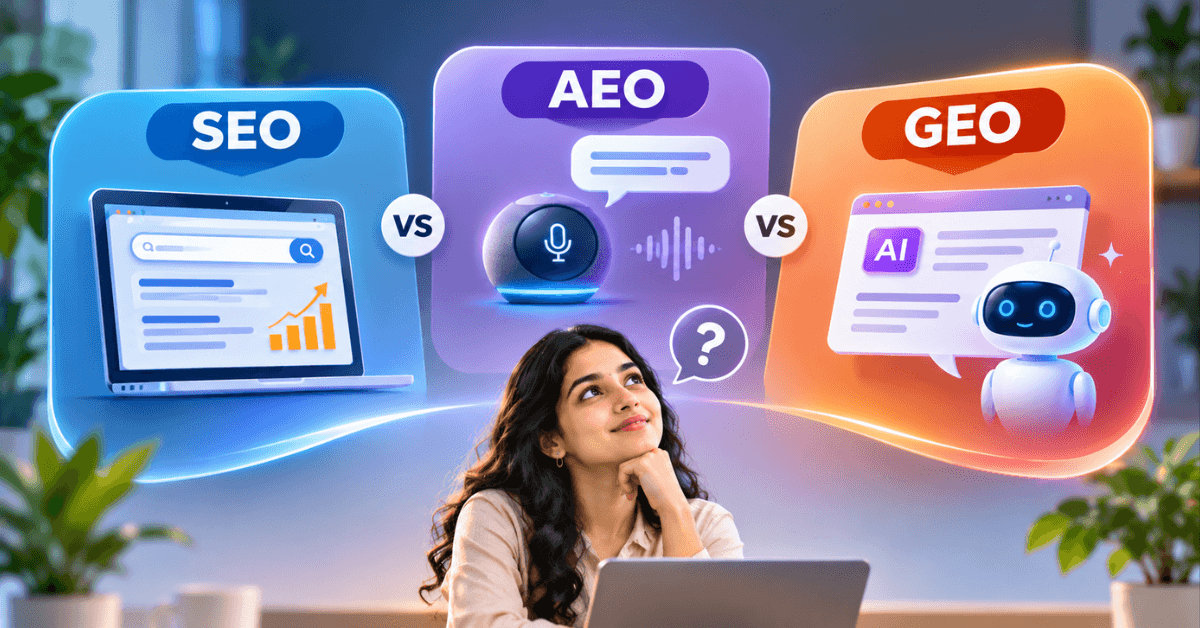
Search strategy is no longer a one-dimensional battle for the classic ten blue links on Google. Over the past decade, discovery has evolved from typed keyword queries into conversational voice interactions, and now into synthetic, generative AI responses. Businesses today encounter a confusing web of acronyms: SEO, AEO, and GEO. While they share the overarching goal of driving brand visibility and organic acquisition, their discovery engines, technical requirements, and content formats operate on fundamentally distinct rules.
Understanding how these three disciplines intersect is essential for any modern brand. Allocating budget exclusively to conventional rankings while ignoring conversational answer models or AI synthesis creates major pipeline vulnerabilities. Conversely, abandoning traditional search foundations entirely can destabilize your technical baseline. Here is the definitive breakdown of SEO, AEO, and GEO, how they differ, and how to orchestrate the ideal mix for your commercial objectives.
Deconstructing the Acronyms: Definitions & Mechanisms
1. Search Engine Optimisation (SEO)
Search Engine Optimisation is the discipline of enhancing a website’s technical architecture, on-page content, and backlink authority so traditional web crawlers (like Googlebot and Bingbot) index and rank pages at the top of Search Engine Result Pages (SERPs). The traditional interaction model relies on a user typing a query, evaluating a list of ranked links, and clicking through to visit your website.
2. Answer Engine Optimisation (AEO)
Answer Engine Optimisation is designed to position your brand as the single, direct answer to explicit, factual questions. AEO powers zero-click SERP features like Google Featured Snippets, Knowledge Panels, and "People Also Ask" boxes, as well as voice-first assistants such as Apple Siri, Google Assistant, and Amazon Alexa. Unlike SEO, where users choose between multiple search results, AEO aims to be the singular authoritative answer selected by an engine.
3. Generative Engine Optimisation (GEO)
Generative Engine Optimisation focuses on structuring, validating, and distributing digital content so that conversational Large Language Models (LLMs) and hybrid generative search platforms—such as Google AI Overviews, Perplexity AI, ChatGPT Search, and Microsoft Copilot—synthesize and cite your brand within AI-generated answers. GEO leverages Retrieval-Augmented Generation (RAG) to reference your proprietary data, case studies, and perspectives in response to multi-step, nuanced prompts.
Head-to-Head Comparison: SEO vs. AEO vs. GEO
While all three strategies aim to capture market share, their internal mechanics and performance indicators differ significantly:
| Comparison Parameter | SEO (Search Engine Optimisation) | AEO (Answer Engine Optimisation) | GEO (Generative Engine Optimisation) |
|---|---|---|---|
| Discovery Platform | Google, Bing, Yahoo search result pages. | Featured snippets, Siri, Alexa, Google Voice Assistant. | ChatGPT, Perplexity, Google AI Overviews, Copilot. |
| User Intent & Query Style | Keywords & short phrases (e.g., "B2B CRM software"). | Specific questions (e.g., "What is the average cost of B2B CRM?"). | Nuanced, multi-prompt scenarios (e.g., "Compare top CRMs for a 20-person team with setup steps"). |
| Output Format | Paginated list of clickable blue URLs. | A single concise answer, snippet box, or spoken voice response. | A synthesized, multi-paragraph contextual summary with embedded source citations. |
| Primary Technical Drivers | Page speed, crawlability, mobile responsiveness, backlink profiles. | Concise schema markup (FAQ, How-To), clear H2/H3 question headers, direct definitions. | Semantic entity depth, machine-readable data tables, original statistics, high information density. |
| Success Metrics | Organic clicks, page impressions, average ranking position. | Featured snippet ownership, zero-click impressions, voice query selections. | LLM citation rate, brand share of voice in AI summaries, high-intent referral traffic. |
Core Capabilities: What Each Strategy Does Best
When SEO Delivers the Highest Return
Traditional SEO remains the undisputed champion for transactional and navigational intent. When prospects know what they want and need to browse products, review pricing structures, or sign up for services, they rely on standard search listings. Ranking your core landing pages, e-commerce collections, and service hubs still drives the highest absolute volume of trackable commercial traffic. If you want to dive deeper into technical crawlability and trust signals, explore our breakdown on domain authority factors.
When AEO Wins the Market
AEO dominates immediate, factual discovery. When users search for quick calculations, procedural steps, definitions, or local business contact details on their phones or smart home devices, AEO captures the top spot. Winning featured snippets allows your brand to dominate mobile real estate above organic links. For localized service operations, pair AEO principles with our dedicated local SEO services to secure the Google Maps 3-Pack and voice search recommendations simultaneously.
When GEO Becomes Irreplaceable
GEO excels at high-consideration research and evaluation cycles. B2B software buyers, medical patients evaluating treatment protocols, and students comparing advanced courses rarely make decisions off a single link or short answer snippet. They use conversational AI engines to synthesize trade-offs, evaluate frameworks, and review recommendations. If your brand is not recognized by LLMs as a credible entity, generative engines will recommend your competitors instead. Learn how to establish this widespread footprint in our guide to building a strong digital presence.
Strategic Matrix: Which Approach Does Your Business Need?
Rather than choosing one framework in isolation, your industry model and sales cycle dictate how you should balance your resources:
| Business Category | Primary Focus | Supporting Disciplines | Execution Blueprint |
|---|---|---|---|
| E-Commerce & Retail | SEO (60%) | GEO (25%), AEO (15%) | Optimize category/product pages for search; deploy GEO product comparison matrices; capture FAQ snippets for sizing and returns. |
| SaaS & Enterprise B2B | GEO (50%) | SEO (35%), AEO (15%) | Publish proprietary industry benchmarks, whitepapers, and integration guides for LLM citations; maintain high-intent SEO service landing pages. |
| Local Clinics & Showrooms | AEO (45%) | SEO (40%), GEO (15%) | Dominate Google Business Profile, voice search queries, and localized service queries; maintain structured local citations. |
| Consultancies & Agencies | GEO (45%) | SEO (40%), AEO (15%) | Showcase detailed client frameworks, case studies, and contrarian perspectives to ensure generative models cite your leadership. |
The Unified Organic Framework: Integrating SEO, AEO, and GEO
Building an adaptable, future-proof acquisition system does not require three separate teams. You can execute an integrated workflow by applying these five sequential principles:
- Establish Technical Hygiene (The SEO Baseline): Eliminate crawl errors, resolve redirect loops, structure canonical tags, and maintain rapid page load speeds. Search engines and AI scrapers alike depend on a stable codebase to access content.
- Structure Content for Direct Extraction (The AEO Layer): Frame subheadings as natural-language questions. Immediately follow them with clear, direct 40-to-60-word answers, bulleted lists, and schema tags (such as
FAQPageandHowTo). - Inject Proprietary Data and Original Research (The GEO Fuel): Incorporate unique survey findings, cost analyses, internal metrics, and named expert quotes. LLMs rely on distinct, verifiable proof points to cite primary sources during retrieval.
- Build Semantic Entity Interlinking: Connect high-level topic hubs, deep-dive guides, and verified case studies within your portfolio to signal deep topical authority across your core subject areas.
- Audit Multi-Channel Conversion Analytics: Track user interactions, form fills, and assisted paths originating from standard search alongside incoming referrals from generative AI domains. Discover how to configure complete attribution models through our analytics and measurement services.
Upskill Your Team on Next-Generation Search
As organic discovery evolves, marketing teams must master both traditional ranking algorithms and modern conversational AI architectures. If your in-house staff or leadership team wants hands-on training covering modern optimization workflows, explore our practical digital marketing training or deep-dive into our specialized AI and automation curriculum.
Frequently Asked Questions
Can a business skip traditional SEO and focus only on GEO?
No. Generative search engines rely on traditional search indexes and crawlers as the underlying data layer for retrieval-augmented generation. If a website lacks basic crawlability, technical stability, and domain authority, generative engines will struggle to discover and validate its content.
How does content formatting differ between AEO and GEO?
AEO requires short, precise, direct answers (typically 40–60 words) immediately following explicit questions to win featured snippets or voice answers. GEO requires comprehensive, high-density content with structured tables, expert citations, and proprietary statistics that LLMs can synthesize into multi-paragraph answers.
How can I track traffic coming from generative engines compared to standard SEO?
In Google Analytics 4, standard organic search is attributed to search engines like Google and Bing. Traffic from generative engines typically appears as referral traffic from domains like chatgpt.com or perplexity.ai, or can be tracked using custom UTM parameters and dedicated exploration reports.
Which discipline provides the fastest return on investment?
For immediate query capture, AEO targeting long-tail, question-based keywords can earn featured snippets quickly if your page already ranks on page one. Traditional SEO builds reliable, compounding inbound volume over 3 to 6 months, while GEO establishes long-term brand authority across evolving AI search models.