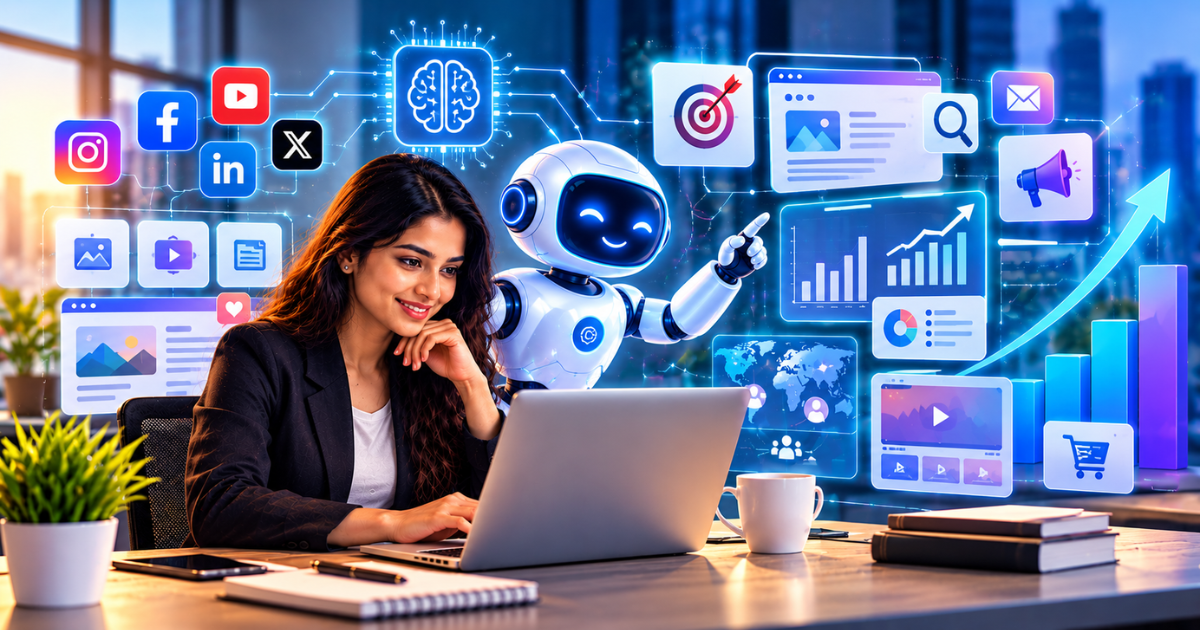
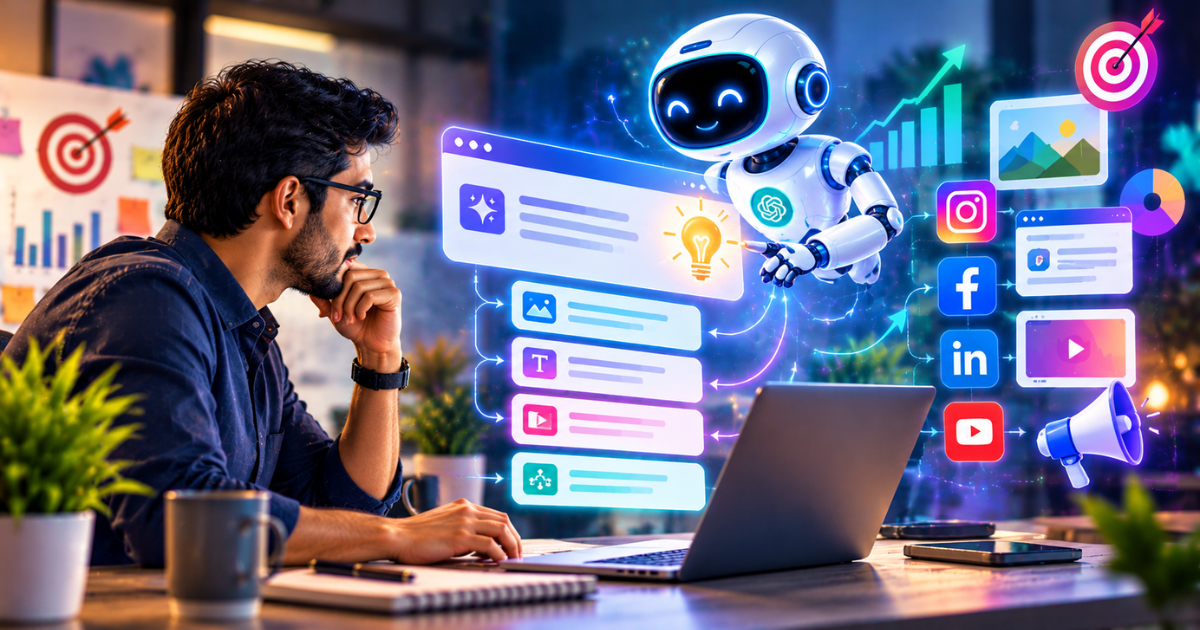
Artificial intelligence is no longer a side experiment in marketing. In 2027, it sits inside almost every tool a marketer touches — the search engine your customers use, the ad platform that spends your budget, the CRM that scores your leads and the analytics dashboard that tells you what worked. For businesses in Bengaluru and across India, the question has shifted from "Should we use AI?" to "How do we use AI without losing the human edge that makes customers trust us?"
In this guide, we break down how AI is changing digital marketing in 2027, what it means for SEO, content, advertising, customer experience and analytics, and the practical steps you can take this year to stay ahead. If you want hands-on help applying these ideas, our AI marketing services are built for exactly this shift.
1. AI Search Is Rewriting the Rules of SEO
Search has changed more in the last two years than in the previous ten. Google’s AI Overviews and AI Mode, along with conversational assistants such as ChatGPT, Gemini, Perplexity and Claude, now answer many questions directly — often before a user clicks a single link. Ranking on page one is no longer the only goal; being cited inside an AI-generated answer matters just as much.
From keywords to entities and intent
AI systems understand topics, entities and relationships rather than matching exact phrases. Pages that win in 2027 answer a question completely, use clear structure, show real expertise and are backed by trustworthy signals such as author bios, reviews and consistent business information.
What this means for your SEO strategy
- Build topical authority with clusters of related content instead of isolated blog posts.
- Use structured data (FAQ, Product, LocalBusiness, Article) so machines can read your pages easily.
- Write concise, quotable answers near the top of each section — the kind AI tools like to cite.
- Strengthen E-E-A-T with first-hand experience, case studies and named experts.
- Keep technical foundations strong: fast pages, clean crawlability and mobile-first design.
This approach is often called Generative Engine Optimisation (GEO) or Answer Engine Optimisation (AEO), but at its heart it is still good SEO done thoroughly. Our search engine optimisation services now include AI-search visibility checks alongside classic rankings. Local businesses benefit even more from a well-managed Google Business Profile and local SEO, because AI assistants draw heavily on map listings and review data.
2. Generative AI Is Scaling Content — But Quality Still Wins
Tools that write, design, edit video and generate voice-overs have made content production dramatically faster. A small team can now produce blog drafts, social captions, ad variations, product descriptions and short-form videos in hours instead of weeks.
The catch is that everyone has the same tools. When the internet is flooded with average AI-written content, the pieces that stand out are those with original insight, real examples, local context and a clear point of view. Google has made it clear that it rewards helpful content regardless of how it is produced — and demotes mass-produced pages that add no value.
A smart AI content workflow for 2027
- Research: Use AI to summarise competitor pages, cluster keywords and find content gaps.
- Outline: Let AI propose structures, then refine them with your own expertise.
- Draft: Generate a first draft, then rewrite it with real experiences, data and your brand voice.
- Edit: Fact-check every claim, add internal links and optimise headings and metadata.
- Repurpose: Turn one strong article into reels, carousels, LinkedIn posts and email newsletters.
If you run a blog or want to start one, our blogging course shows how to combine AI speed with the human storytelling that builds a loyal audience.
3. Hyper-Personalisation at Scale
Personalisation used to mean adding a first name to an email. In 2027, AI analyses browsing behaviour, purchase history, location and engagement in real time to decide which product, offer, message and even send time each person sees.
E-commerce stores now recommend products the way streaming apps recommend shows. Websites change headlines and banners based on traffic source. Email and WhatsApp campaigns trigger automatically when a customer abandons a cart, revisits a pricing page or hasn’t purchased in a while.
The key is using first-party data responsibly. With India’s Digital Personal Data Protection (DPDP) Act and its rules being phased in, and third-party tracking fading, businesses that collect consent-based data — through forms, loyalty programmes, quizzes and newsletters — will personalise better than those relying on rented audiences. Clean tracking through GA4 and Google Tag Manager is the foundation for all of it.
4. AI-Powered Advertising and Predictive Bidding
Google Ads Performance Max, AI Max for Search and Meta’s Advantage+ campaigns have shifted control from manual settings to machine learning. The algorithms decide placements, bids, audiences and even creative combinations based on the conversion signals you feed them. This changes the marketer’s job. Instead of adjusting bids by hand, the winning skills in 2027 are:
- Feeding accurate conversion data — including offline sales and lead quality — back to the platforms.
- Producing a wide variety of creative assets (images, videos, headlines) for AI to test.
- Setting clear business goals such as target ROAS or cost per qualified lead.
- Reading reports critically and knowing when automation is wasting money.
Our performance marketing training covers Google and Meta ads in this AI-first world, so you learn to guide the algorithm rather than fight it.
5. Chatbots, AI Agents and Conversational Marketing
Customers expect instant answers at any hour. AI chatbots on websites, WhatsApp and Instagram now handle FAQs, qualify leads, book appointments and recommend products in natural language — in English, Hindi, Kannada and many other Indian languages.
The next step is AI agents that complete tasks rather than just answer questions. Shoppers are beginning to ask assistants to compare products, check availability and even place orders on their behalf. To be "agent-ready", your website needs accurate product data, clear pricing, structured information and a smooth checkout. Conversational marketing works best when the bot knows its limits and hands complex or sensitive conversations to a human quickly.
6. Smarter Analytics and Predictive Insights
AI has turned analytics from rear-view reporting into forward-looking guidance. GA4’s predictive metrics estimate purchase probability and churn risk, while AI assistants built into analytics tools let you ask plain-language questions such as "Which channel brought the most qualified leads last month?"
Marketers can now spot anomalies automatically, forecast demand for festive seasons like Diwali and model which channels truly drive revenue. But insights are only as good as the data behind them — messy tracking leads to confident but wrong recommendations. Our Looker Studio training and Google Tag Manager course help marketers turn raw data into reliable decisions.
7. Voice, Visual and Multimodal Search
People increasingly search by speaking to their phones, pointing their camera at a product with Google Lens or uploading an image to an AI assistant. Multimodal AI understands text, images, audio and video together, so your content needs to be readable in every format:
- Use descriptive file names, alt text and captions for images.
- Add transcripts and chapters to videos.
- Answer natural, conversational questions in your content.
- Keep your name, address and phone number consistent everywhere for "near me" voice queries.
The Human Skills AI Cannot Replace
For all its power, AI does not understand your customers the way you do. It cannot build genuine relationships, take ethical responsibility or create a brand story rooted in lived experience. The marketers who thrive in 2027 combine AI fluency with strategy, creativity, empathy and critical thinking.
That is why upskilling matters. Whether you are a business owner, a working professional or a student, learning to use AI tools properly — including prompt engineering and workflow automation — is now a core marketing skill. Our AI & Automation course and complete digital marketing training in Bangalore are designed around this reality. If you are weighing up the field, read our post on the top reasons to choose digital marketing as a career.
How to Start Using AI in Your Marketing This Year
- Audit your current marketing and list repetitive tasks AI can take over.
- Fix your data foundations — tracking, consent and CRM hygiene.
- Pick two or three AI tools and build simple, documented workflows.
- Keep a human review step for every piece of public-facing content.
- Measure results against clear KPIs and scale what works.
Not sure where to begin? Explore our digital marketing strategy services or book a free 20-minute consultation with Akash Tonasalli to map out an AI-ready plan for your business. You can also read our companion guide on digital marketing trends every business should watch in 2027.
Frequently Asked Questions
Will AI replace digital marketers in 2027?
No. AI automates repetitive tasks such as drafting, reporting and bid management, but strategy, creativity, brand judgement and customer relationships still need people. Marketers who use AI well will outperform those who don’t.
Is AI-generated content bad for SEO?
Not by itself. Google rewards helpful, accurate, original content regardless of how it is created. Problems arise when AI is used to mass-produce thin pages without human review or real expertise.
What are GEO and AEO?
Generative Engine Optimisation and Answer Engine Optimisation are practices that help your content get cited in AI-generated answers from tools like Google AI Overviews and ChatGPT. They build on core SEO with clearer answers, structured data and stronger authority signals.
How can a small business in India start with AI marketing?
Start small: use AI for content drafts, a WhatsApp chatbot for common questions and GA4 predictive insights. Make sure your Google Business Profile and website basics are strong first — AI amplifies what already works.